Most people will not lose their job because of AI, but because of overusing AI
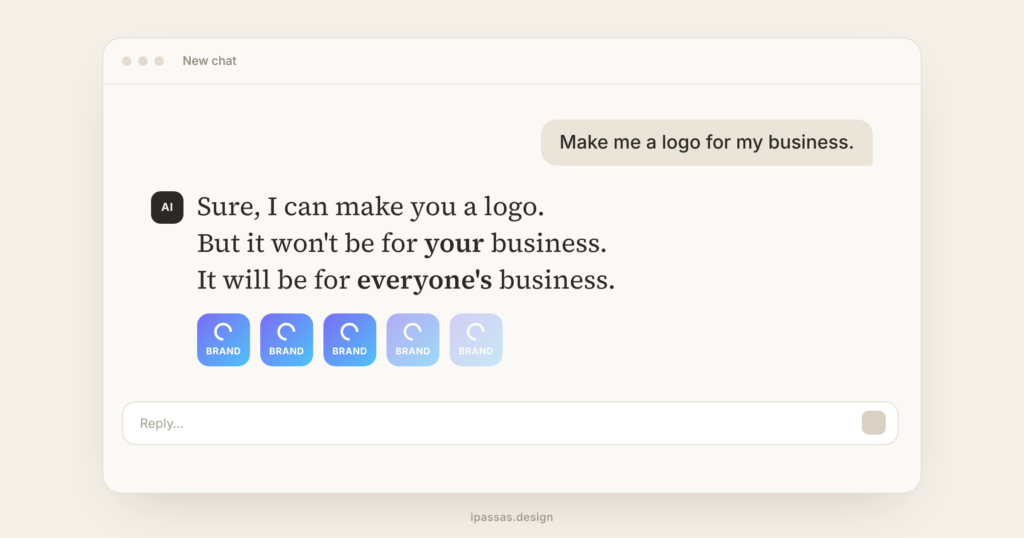
I keep seeing amazing ideas made with AI. Clever concepts, beautiful layouts, sharp interfaces. Then I see the same amazing idea again. And again. Five times, ten times, a hundred times.
The first time, it’s impressive. By the tenth, it’s background noise. By the hundredth, it’s annoying.
This is not a piece against AI. It’s a piece against handing it everything.
AI is my third hand
Let me be clear about where I stand. I use AI every single day. Right now it’s like a third hand.
I give it tasks. It drafts and sends emails so I can stay 100% focused on the work that actually needs me. I even built a small program on my computer so I don’t have to type messages anymore. I switch between apps, I speak, and the message appears. And it writes the way I write: the same shortcuts, the same missing letters, the same small spelling mistakes. I trained it on me, and it sounds like me.
That alone saves me roughly 20% of my day.
So AI works. It works brilliantly. But notice what made it work: I decided what it does, I trained it, and I’m still the one talking.
The sameness problem
Open ten new apps and count how many look alike. The same hero section. The same big title with a smaller line under it. The same logo on the left, button on the right. The same soft gradients, the same rounded cards, the same three icons in a row.
Scroll through social media and it’s the same story with posts. Same structure, same layout, same “polished” feel. Technically good. Instantly forgettable.
This isn’t only a feeling. In 2024, researchers Anil Doshi (UCL) and Oliver Hauser (University of Exeter) published a study in Science Advances where writers created short stories, some with AI-generated ideas and some without. The stories written with AI help were rated as more creative and better written, especially for less creative writers. But they were also more similar to each other. The authors described it as a social dilemma: each person is better off individually, but together we produce a narrower range of new ideas.
That’s exactly what I see in design. Every single output looks good. Put them side by side and they all look the same.
Honestly, I would rather open a buggy app with a real personality than a flawless copy of the last ten apps I used. I would rather see a rough post with a spelling mistake, clearly made by a person, than another perfect template.
When companies go AI from core to end
Using AI for a task is smart. Using AI for everything, from the core of the business to the last customer touchpoint, is where it gets dangerous.
Klarna is the clearest example so far. In early 2024, after a long hiring freeze, the company announced its AI assistant was doing the work of around 700 customer service agents. By 2025, CEO Sebastian Siemiatkowski was publicly admitting that the push had focused too much on cost and led to lower quality, and the company started hiring human support staff again.
Most companies won’t make headlines like that. They’ll just slowly become forgettable. Their product looks like everyone else’s, their content sounds like everyone else’s, and customers can’t tell them apart. Maybe they don’t feel it yet. Maybe none of us do. But it’s coming.
Why this is really about your job
Here’s the uncomfortable part. If your work is exactly what the AI gives everyone, you can be replaced by anyone with the same subscription. Not by the AI. By the next person with the same prompt.
Your value has always been the part that’s different: your taste, your judgment, the strange idea nobody else had, the decision to break the pattern. Overusing AI quietly removes exactly that part.
There’s also a cost to your own thinking. A 2025 MIT Media Lab study, “Your Brain on ChatGPT,” followed 54 people writing essays with ChatGPT, with a search engine, or with nothing at all. The ChatGPT group showed the weakest brain engagement, felt less ownership of their essays, and struggled to recall what they had just written. The researchers called it “cognitive debt.” People who wrote on their own first and brought in AI later showed much stronger engagement. It’s a small study and the researchers say so, but the direction matches what many of us already feel: the less we think, the less we can.
So most people won’t lose their job because AI got good. They’ll lose it because they stopped doing the part AI can’t.
If you have no budget, use it
I’m not judging anyone. If you’re a small business and you can’t afford a designer or a developer, use AI. Do it. It works, it’s an amazing tool, and it will help your business grow.
Just remember: it’s a tool. A hammer doesn’t build a house. The person holding it does.
How to use AI without disappearing
- Think first, prompt second. Have your own idea before you ask for one.
- Train it on you. Your voice, your style, your rules. Generic input gives generic output.
- Keep the decisions human. Direction, taste and the final call stay with people.
- Train your people to work beside it, not to wait for it to do their work.
- Break the default. If it looks like what AI gives everyone, change it until it doesn’t.
- Leave room for imperfection. A human mistake is often more memorable than a perfect template.
The bottom line
AI will not take your job. Becoming indistinguishable will.
Use it every day. Let it be your third hand. Just don’t let it become your head.
References
- Doshi, A. R., & Hauser, O. P. (2024). Generative AI enhances individual creativity but reduces the collective diversity of novel content. Science Advances, 10(28). doi.org/10.1126/sciadv.adn5290
- Kosmyna, N., et al. (2025). Your Brain on ChatGPT: Accumulation of Cognitive Debt when Using an AI Assistant for Essay Writing Task. MIT Media Lab.
- Entrepreneur (2025). Klarna Is Hiring Customer Service Agents After AI Couldn’t Cut It on Calls. entrepreneur.com

Written by Iordanis Passas, creative director, graphic designer and UI designer who designs with AI.